About Me
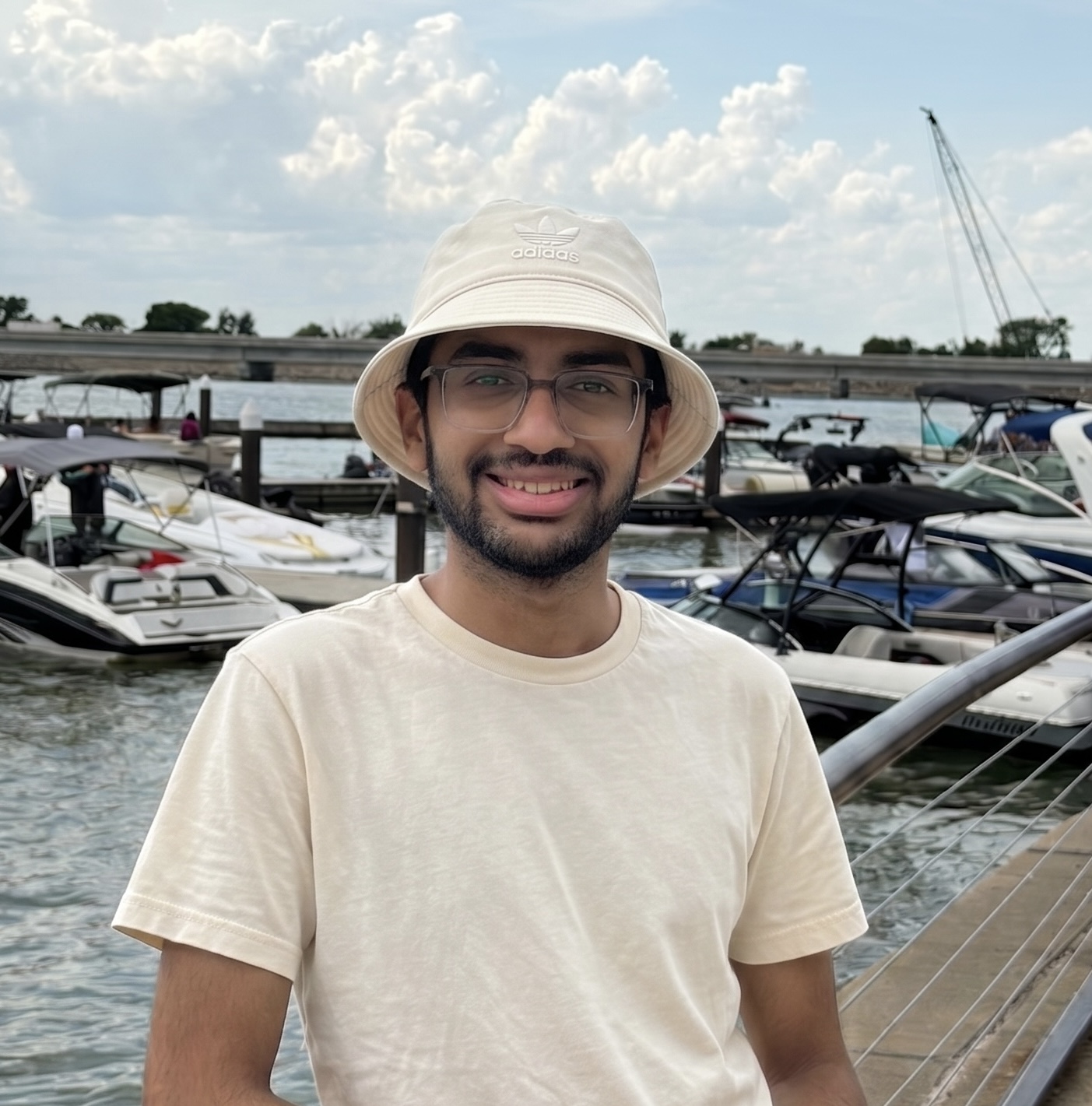
I'm a 2nd-year Master's student in Computer Science at UT Dallas, working on my master's thesis with Prof. Yapeng Tian. My research sits at the intersection of Computer Vision and NLP — I'm particularly excited about multimodal learning and how vision, language, and audio can be jointly understood.
Outside of research, I love exploring new hobbies and staying active. These days you'll find me social dancing, hunting for great cafes, or playing pickleball and badminton.
Publications
AI-Driven Gait Classification Using Portable Wearable Sensors: Advances and Case Study
Sonam Nahar, Preet Sojitra, and Vineet Vashista
Chapter in "Design and Control of Rehabilitation Robots", Springer, July 2025.
Experience
Student Collaborator @ Computer Vision and Multimodal Computing Lab, UTD
September 2025 - Present · Supervisor: Prof. Yapeng Tian
- Building a large-scale, high-quality audio-visual dataset for training generative models, with a focus on curation at scale.
- Designed and implemented a distributed filtering and processing pipeline on the UTD HPC cluster using SLURM and parallel I/O, handling hundreds of thousands of audio-video samples.
- Next phase: training and evaluating diffusion-based audio-visual generation models on the curated dataset.
Student Assistant @ HPC Center, UTD
May 2025 - Present · Part-Time
- Support researchers in debugging HPC workflows, MPI/OpenMPI configs, CUDA environment setup, and SLURM job failures.
- Work on cluster operations including job scheduling, resource allocation, and parallel programming best practices.
- Primary areas of expertise: SLURM, OpenMPI, CUDA, and distributed/parallel programming.
AI & NLP Research Intern @ 9series Pvt Ltd
Feb 2025 - Jun 2025
- Engineered an end-to-end computer vision system using YOLOv8 to detect and classify counterfeit luxury goods, achieving over 95% classification accuracy on real-world data.
- Developed and deployed the system's backend with FastAPI on AWS, integrating it directly into the client's Shopify store and e-commerce platform.
- Architected and implemented a scalable inference pipeline using Celery and Redis to manage high-volume asynchronous requests, significantly reducing API response latency.
- Utilized explainable AI techniques like Grad-CAM to validate model behavior and ensure decision transparency.
- Led the fine-tuning of Large Language Models (Llama 3, Gemma) to automate the classification of customer chargeback disputes.
- Generated a synthetic, multi-turn conversational dataset to train the models to identify valid disputes by interacting with customers.
- Implemented LoRA-based fine-tuning using Unsloth and Hugging Face, successfully teaching the model to recognize dispute categories and adopt a specific conversational tone.
Research Intern @ HCR Lab, IIT Gandhinagar
May 2024 - Oct 2024
- Conducted a 5-month research project on AI-driven gait analysis using wearable sensor data, managing the full project lifecycle from participant data collection to final analysis.
- Developed and benchmarked deep learning models (GRUs and 1D-CNNs) for time-series classification of IMU sensor data to identify gait patterns.
- This work culminated in a book chapter published by Springer (see Publications section).
Featured Projects
Echo-ViLD: Zero-Shot Acoustic Object Localization
CS 6384 — Computer Vision, UTD
Extended ViLD (open-vocabulary object detection) by replacing CLIP with Meta's PEAV (Perception Audio-Visual-Text) foundation model, enabling a tri-modal detection framework where users can query with audio instead of text. A custom Segment-Guided Distillation pipeline uses SAM to produce background-free, mask-accurate embeddings as teacher targets, eliminating the noisy rectangular crop artifacts that degrade standard OVD distillation.
The result is true Zero-Shot Acoustic Object Localization: given a
.wav audio clip, the model localizes the sounding object
in an image with no category-specific training. Validated on a 5K COCO
subset (resource-constrained), with results on par with baseline ViLD.
Adaptive Speculative Decoding for LLM Inference
CS 6320 — NLP, UTD
Built a speculative decoding engine from scratch in PyTorch targeting Python code generation. Standard speculative decoding uses a small draft model to speculatively generate tokens that a larger target model then verifies, fast when accepted, wasted compute when not.
Introduced two optimizations: Teacher-Student Alignment, aligning the draft model's distribution to the target via top-K KL-divergence loss to directly improve token acceptance rate (α) and Dynamic Lookahead Halting , a lightweight 2-layer MLP trained on draft entropy and token confidence that halts speculation early when uncertainty is high, cutting wasted FLOPs. Both hypotheses were experimentally confirmed.
Depression Detection through Speech Analysis
An end-to-end research project to detect depression from speech recordings using the DAIC-WOZ dataset. Systematically evaluated a range of models, from classic CNNs (VGGNet, ResNet) to Vision Transformers (ViT), on spectrograms and raw audio data.
Accomplishment: Gained experience in the full research pipeline, including feature engineering for audio, comparative model benchmarking, and handling class imbalance.